Something lurks in lakes, rivers, and even household taps across the globe. It cannot be seen with the naked eye. It survives conditions that would kill most other microbes. And when it finds its way into a human brain, it almost always wins.
Scientists are now urging the world to pay attention to an enemy that has long escaped public notice. Free-living amoebae, single-celled organisms found in soil and water on every continent, have begun appearing in headlines with alarming frequency. While most of these microscopic creatures pose no danger to humans, a small subset can cause infections so severe that survival rates hover near zero.
Environmental and public health researchers have published new warnings about these pathogens in peer-reviewed journals, calling for immediate action. Their message is clear. We are not prepared for what may be coming.
Outbreaks Across Continents
In 2025, Kerala, India, experienced an outbreak that sent shockwaves through public health communities. Naegleria fowleri, an organism commonly called the brain-eating amoeba, infected 69 people and killed 19. Families in the region watched helplessly as loved ones succumbed to an infection most had never heard of before.
India was not alone. In China, multiple infections among children in several provinces sparked widespread concern on social media. Most cases traced back to water-based recreational activities during summer break. Parents who had encouraged their children to cool off in local waterways now faced an invisible danger they could neither see nor predict.
More than 500 cases have been reported across 33 countries to date. Nations including Mexico, Australia, and Pakistan have documented infections, though cases span Asia, Africa, Europe, and Oceania. Between 1962 and 2024, 167 cases of primary amoebic meningoencephalitis occurred in the United States. Only four people survived.
Numbers like these demand attention. Yet for decades, amoebae have remained on the periphery of biosecurity research, overshadowed by bacteria, viruses, and other more familiar threats.
Naegleria fowleri thrives in warm freshwater environments. Lakes, rivers, hot springs, and poorly maintained swimming pools all provide suitable habitats. Tap water systems with inadequate treatment can also harbor these organisms.
Infection does not occur through drinking contaminated water. Instead, the amoeba enters through the nose, typically during activities like swimming, diving, or jumping into freshwater. From the nasal passages, it travels along the olfactory nerve directly into the brain. Once there, it begins consuming tissue.
Certain cultural and religious practices create additional pathways for infection. Ceremonial bathing rituals and nasal irrigation using neti pots have both been linked to cases. Anyone who introduces untreated water into their nasal passages faces potential risk, no matter how small it may seem.
Children and young adults account for many infections, likely because they engage more frequently in water activities that involve submersion and splashing. Hot summer months, when water temperatures rise and levels drop, create ideal conditions for amoeba proliferation.
Rapid Destruction
Primary amoebic meningoencephalitis, or PAM, destroys brain tissue with terrifying speed. Early symptoms mimic common illnesses. Headache, fever, nausea, and vomiting often appear first, leading many patients and physicians to suspect less serious conditions.
Within days, symptoms escalate. Stiff neck, confusion, and loss of balance follow. Hallucinations and inability to focus on surroundings signal advanced infection. Most patients slip into a coma.
Case fatality rates exceed 97 percent. Death typically occurs within one to 18 days after symptoms begin, often within just five days. By the time doctors recognize what they are dealing with, treatment options have narrowed to near impossibility.
Other pathogenic amoebae cause similarly devastating conditions. Acanthamoeba species can infect the cornea, causing a sight-threatening condition often associated with contaminated contact lenses. Balamuthia mandrillaris enters through skin wounds or nasal passages and can spread to the brain, causing granulomatous amoebic encephalitis with an equally grim prognosis.
Built to Survive
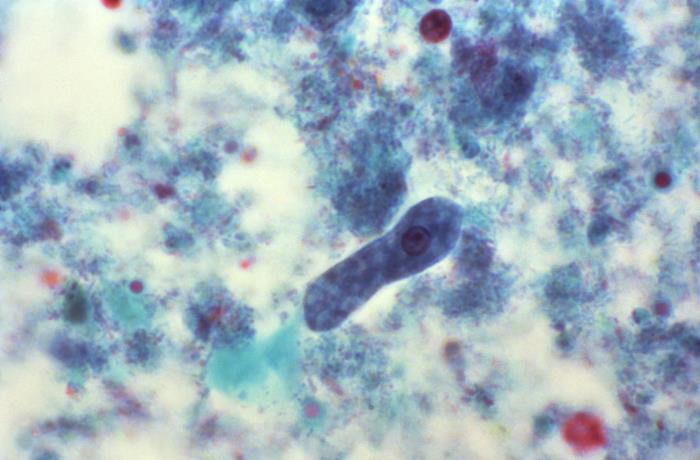
Image credit: CDC / Dr Mae Melvin
“What makes these organisms particularly dangerous is their ability to survive conditions that kill many other microbes,” said Longfei Shu, corresponding author of a recent perspective article on amoeba-related health risks and a researcher at Sun Yat-sen University. “They can tolerate high temperatures, strong disinfectants like chlorine, and even live inside water distribution systems that people assume are safe.”
Standard water treatment processes that eliminate most pathogens prove far less effective against amoebae. In cyst form, these organisms can withstand conditions that would destroy bacteria and viruses many times over. Some Acanthamoeba species survive chlorine concentrations as high as 100 milligrams per liter for 10 minutes. Conventional UV disinfection at germicidal wavelengths shows limited effect against resistant cysts.
Perhaps most concerning, sublethal chlorine exposure may actually increase virulence in some species by triggering expression of genes associated with pathogenicity. Treatment meant to protect public health could, under certain conditions, make these organisms more dangerous.
Amoebae colonize water distribution pipes, swimming pools, and point-of-use filters. Biofilms within plumbing systems provide protected environments where these organisms can persist and multiply. Membrane filtration, another common treatment approach, can be compromised when amoebae use filter surfaces as growth interfaces.
Hidden Carriers
Direct infection represents only part of the threat amoebae pose. Scientists have identified another mechanism that amplifies their danger to public health.
Amoebae act as predators in microbial ecosystems, consuming bacteria, fungi, and viruses through a process called phagocytosis. Most ingested microbes die within the amoeba cell. But certain bacteria have evolved to resist destruction. These amoeba-resisting bacteria not only survive inside their hosts but can multiply and eventually escape back into the environment.
Dangerous human pathogens, including Legionella pneumophila, the cause of Legionnaires’ disease, and Mycobacterium tuberculosis, can persist within amoebae. Protected inside these cellular fortresses, such bacteria evade disinfection treatments and gain extended environmental persistence. Some evidence suggests that passage through amoebae may actually enhance bacterial pathogenicity.
Recent research found human norovirus and adenovirus surviving inside amoebae, effectively bypassing UV and chlorine treatments designed to eliminate them from water supplies. Amoebae also carry antibiotic resistance genes, raising concerns about their role in spreading antimicrobial resistance through aquatic and soil ecosystems.
Scientists describe this phenomenon as a Trojan horse effect. Water treatment kills exposed pathogens while leaving those hidden within amoebae unharmed. Protected bacteria and viruses then emerge into systems assumed to be safe.
Warming Waters, Expanding Range
Climate change threatens to worsen an already concerning situation. Rising global temperatures are expected to extend habitats for heat-loving species like N. fowleri into regions where they were previously rare or absent.
Hotter, longer summers produce higher water temperatures and lower water levels in lakes and rivers. Both conditions favor amoeba proliferation. Areas that once experienced cold winters capable of suppressing these organisms may lose that natural protection as temperatures climb.
Cases have already appeared in locations where infections were once unheard of. Environmental changes compound risks from aging water infrastructure in many countries. Pipes installed decades ago may harbor biofilms and create conditions favorable to amoeba colonization.
Public health systems designed around historical disease patterns may find themselves unprepared for infections emerging in new geographic areas. Healthcare providers unfamiliar with amoebic diseases could miss early diagnosis opportunities, reducing already slim survival chances.
Diagnostic Failures
Identifying amoebic infections presents enormous challenges. Traditional microscopy and culture methods often fail to confirm cases. Under a microscope, amoebae can be confused with yeast, macrophages, or other cellular artifacts. Without clear visual identification, clinicians may not pursue molecular testing capable of detecting these pathogens.
Specialized laboratory tests required for definitive diagnosis remain available in only a handful of facilities worldwide. In low-resource settings where many infections occur, such testing may be entirely inaccessible. Diagnosis sometimes happens only after a patient has died.
Historical diagnostic limitations mean the actual burden of amoebic disease almost certainly exceeds reported numbers. Many infections were likely misdiagnosed as bacterial meningitis or other conditions. Some cases may have gone entirely unrecognized.
Improved diagnostic tools represent a key priority for researchers working on this problem. Rapid, affordable point-of-care tests could enable earlier detection and treatment, potentially improving survival rates.
Protection and Prevention
Individuals can take steps to reduce their risk of infection. Holding the nose shut or wearing nose clips when jumping or diving into freshwater provides a physical barrier against amoeba entry. Keeping the head above water in hot springs eliminates the primary infection route.
Avoiding disturbance of sediment in shallow, warm areas reduces exposure to environments where amoebae concentrate. Swimming during hot weather when water levels have dropped warrants particular caution.
For those who use nasal irrigation devices, the water source matters enormously. Only distilled or boiled water should be used for sinus rinsing. Tap water, even in areas with treated municipal supplies, may contain amoebae capable of causing fatal infection.
Public awareness of these prevention measures remains limited. Many people have never heard of brain-eating amoebae or understand how to protect themselves during water activities.
A Call for Global Action
In 2025, the World Health Organization issued guidelines specifically for controlling N. fowleri in drinking water systems. For researchers who have spent years studying these pathogens, the guidelines represented long-overdue recognition of a serious threat.
Scientists are calling for a One Health approach that connects human health, environmental science, and water management into coordinated systems. Surveillance networks capable of detecting amoebae in water supplies before infections occur could prevent outbreaks. Advanced treatment technologies may offer solutions where conventional methods fall short.
“Amoebae are not just a medical issue or an environmental issue,” Shu said. “They sit at the intersection of both, and addressing them requires integrated solutions that protect public health at its source.”
Research gaps remain substantial. Scientists lack species-specific data on how effectively different disinfection strategies work against various amoebae. Ecological factors driving the emergence and spread of pathogenic species require further study. Therapeutic options for infected patients remain limited and largely ineffective.
Public education campaigns targeting high-risk activities and seasons could reduce exposure. Coordinated data sharing between clinical facilities, environmental monitoring programs, and wastewater management systems would create more complete pictures of where threats exist.
According to researchers, there is “an urgent need for more proactive public health surveillance and intervention efforts.”
Brain-eating amoeba remains rare. Most people who swim in lakes and rivers will never encounter these organisms. But rarity offers cold comfort to families who have lost loved ones to infections that might have been prevented.
As waters warm and infrastructure ages, the window for action may be closing. Scientists have sounded their
Some of the links I post on this site are affiliate links. If you go through them to make a purchase, I will earn a small commission (at no additional cost to you). However, note that I’m recommending these products because of their quality and that I have good experience using them, not because of the commission to be made.







 JOIN OVER
Comments